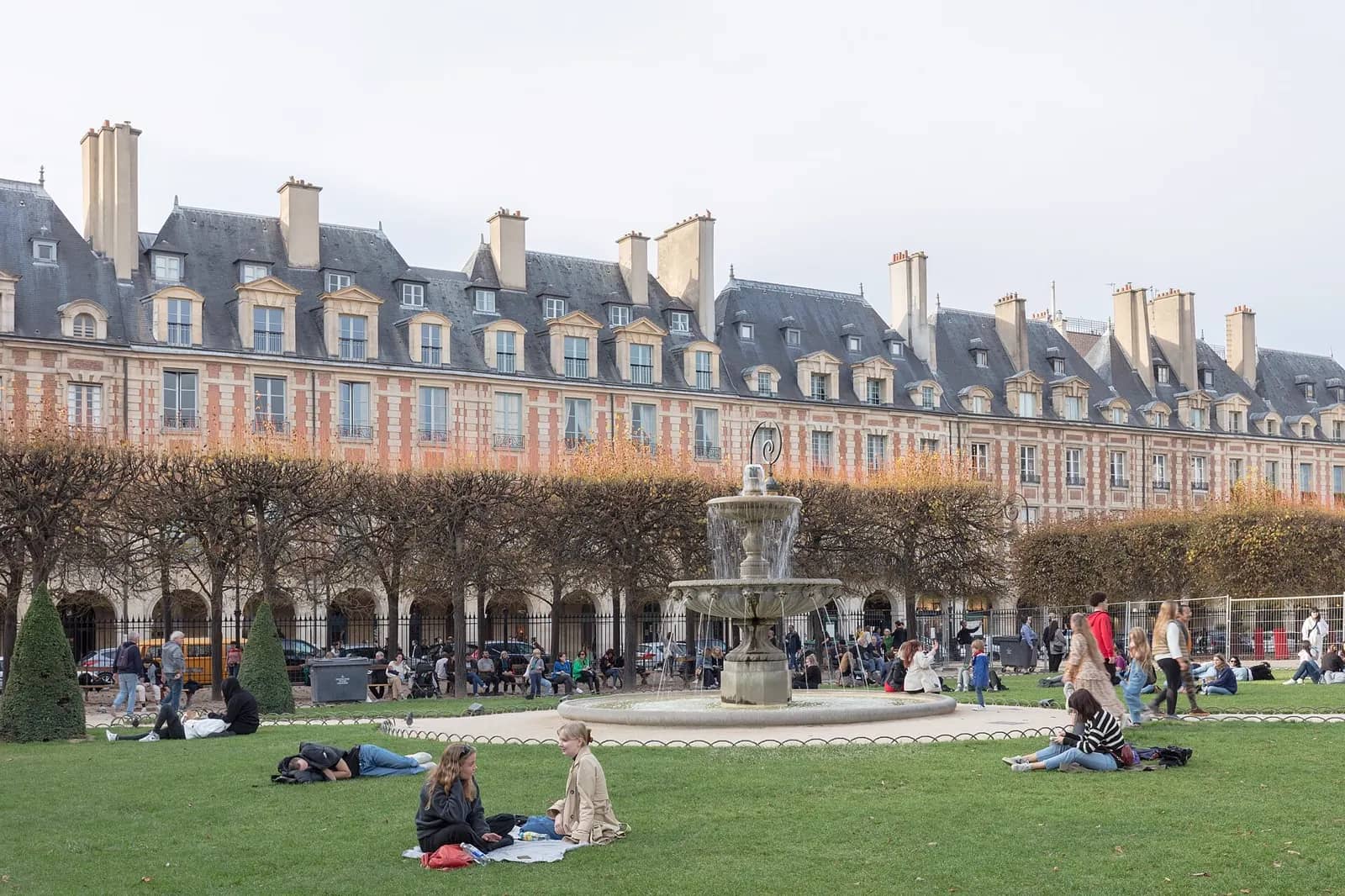
The red-brick pavilions and garden of the Place des Vosges in the Marais, Paris

Paris walking tours · 3 min read

Le Marais Walking Route: What to See in Paris’s Oldest Quarter

The Marais is the part of Paris that survived Haussmann: narrow lanes, aristocratic mansions, the historic Jewish quarter and the most beautiful square in the city. This route links its essential stops in a logical order, in about two hours on foot, and explains what you are looking at.

Written and reviewed by

Amine

Founder and Paris pub crawl host since 2023

Amine leads Meet, Drink & Party, whose Paris team has welcomed more than 10,000 guests. He writes from direct experience organising nightlife events, answering traveller questions and supporting guests during the evening.

How this guide was created

This route was researched using official Paris tourism, museum and RATP information, then reviewed by our Paris-based team. Opening hours, access and transport can change.

Le Marais
Diego Delso · CC BY-SA 4.0

Self-guided audio in 6 languages: English, French, Spanish, German, Italian, Portuguese. · 10 €

Le Marais

Hôtel de Sens → Rue des Barres & Saint-Gervais → Rue François-Miron · the half-timbered houses → Rue Vieille-du-Temple → Rue des Rosiers · the Pletzl → Rue des Francs-Bourgeois → Musée Carnavalet → Musée Picasso · Hôtel Salé → Marché des Enfants-Rouges → Place des Vosges → Victor Hugo's house · 6 Place des Vosges → Hôtel de Sully

Explore this route →

Where to start: the Hôtel de Sens

Start at the Hôtel de Sens, near the Seine and the Pont Marie metro. It is one of the very few medieval private residences left in Paris, with pointed turrets that make it look like a small castle. Look for the cannonball from the 1830 revolution stuck in its façade.

From there, walk up Rue des Barres, a cobbled lane under the flying buttresses of Saint-Gervais. It is the best place to imagine Paris before the great boulevards.

  • Nearest metro: Pont Marie or Saint-Paul (line 1)
  • Best time: weekday mornings, before the shops open
  • Allow 1½–2 hours for the full route

Rue Vieille-du-Temple and the gay Marais

Cross Rue de Rivoli into Rue Vieille-du-Temple, the lively spine of the district. Its name recalls the Knights Templar. From the late 1970s, bars and shops around Rue Sainte-Croix-de-la-Bretonnerie made the Marais the heart of LGBTQ+ Paris, and brought life back to a run-down neighbourhood.

Rue des Rosiers: the Pletzl and its falafel

Rue des Rosiers is the centre of the Pletzl, the historic Jewish quarter shaped by families from Central and Eastern Europe, and later from North Africa. Take time to read the commemorative plaques: they name residents deported during the Second World War. The Mémorial de la Shoah, free to visit, is a few minutes south.

Then eat like a local: a falafel pitta, eaten standing in the street. Many shops close on Saturdays for the Sabbath.

Carnavalet and the Musée Picasso

Rue des Francs-Bourgeois is lined with grand carriage gateways: in the seventeenth century, your address was your reputation. Turn into Rue de Sévigné for the Musée Carnavalet, the museum of the history of Paris, whose permanent collection is free. Madame de Sévigné, the most famous letter writer in French history, lived here.

A few streets north, the Hôtel Salé, built for a salt-tax collector, now holds the Musée Picasso, created after Picasso's heirs paid their inheritance tax in artworks.

Finish at the Place des Vosges

End the walk at the Place des Vosges, inaugurated in 1612 as the Place Royale: thirty-six brick-and-stone houses around a garden, and arcades for a coffee. Victor Hugo's apartment at number 6 is a free museum.

If you would like the stories told on site, with a GPS map and directions, our Le Marais self-guided audio tour follows exactly this route. From the Marais, the Île de la Cité is a ten-minute walk across the Seine.

  • Hôtel de Sens
  • Rue des Barres and Saint-Gervais
  • Rue Vieille-du-Temple
  • Rue des Rosiers
  • Rue des Francs-Bourgeois
  • Musée Carnavalet
  • Musée Picasso
  • Place des Vosges

FAQ

Questions travellers ask

How long does it take to walk around the Marais?

Allow about two hours for the main sights at a relaxed pace, more if you visit Carnavalet, the Musée Picasso or Victor Hugo's house.

Is the Marais open on Sundays?

Yes. Rue des Francs-Bourgeois is one of the few Paris streets where shops open on Sundays, but many shops on Rue des Rosiers close on Saturdays.

Which museums in the Marais are free?

The permanent collections of the Musée Carnavalet and Victor Hugo's house are free. The Musée Picasso requires a ticket.

Self-guided audio in 6 languages: English, French, Spanish, German, Italian, Portuguese.

Explore Paris with a self-guided audio tour

Self-guided audio in 6 languages: English, French, Spanish, German, Italian, Portuguese. About 1½ to 2½ hours, depending on your pace. · 10 €

Explore this route →

Continue reading

Related guides

Paris walking toursÎle de la Cité Walking Route: Historic ParisRead article →Paris walking toursLatin Quarter Walking Route: What to VisitRead article →Paris walking toursBelleville Walking Route: Street Art, Views and the Canal Saint-MartinRead article →

Useful official references

Venue programmes, prices and transport can change. Check current official information before travelling.

Walking tours→